Pages

Showing posts with label herbal medicine. Show all posts

Saturday, August 24, 2013

Weedy Green Juice


Leggy oregano tops.
I spent a good hour or two this morning out in the herb garden, trying to return some sense of order to what had become a desperately overgrown situation. The Greek oregano was all legs and flowers. Ditto for peppermint and lemon balm. Not to mention the comfrey.

And then there were the actual weeds. So-called simply because they show up on their own, rather by design. Most weeds I know have their own charm and value, be it leaf shape, flower or medicinal property. Case in point: blood-building yellow dock, detoxifying dandelion, and my favorite, majestic mullein, whose fuzzy leaves, steeped in water, make an excellent lung tonic. Or, if you prefer, steep her yellow flowers in olive oil for an effective earache remedy.

When mullein shows up at my house, she's always welcome. Just look at her! Who wouldn't want this kind of royalty guarding their front door?

Mullein, the Queen.
Anyway, it's late August and the back garden was getting out of hand, so I had at it. By ten am I had a whole, overflowing wheelbarrow full of weeds and trimmings:


Plus (bonus!) a nice bunch of fresh clippings for making weedy green juice. Here's what went into the mix:

2 large bunches dandelion leaves
1 medium bunch peppermint stalks
2 sprigs of leggy oregano and lemon balm
4 six-inch long slicing cucumbers
1/2 lime
1 granny smith apple

Because of the juicy cucumber base, I chose the Breville juicer today. Accidentally ran it on high speed, so the juice came out pretty foamy, but that's ok. Foamy or not, it's still incredibly delicious... clean, light and perfectly refreshing. Yum!

Now, back to the garden...
Weedy green juice, and friend.

Thursday, July 12, 2012

Peppermint Kiss Sweet Green Juice

Peppermint is one of my all time favorite flavors, and right now, my little herb garden is producing a bumper crop. One of the most delicious medicinal herbs, peppermint is a wonderful digestive soother and breath freshener, a superb respiratory decongestant and a mild stress reliever. Even the scent of peppermint alone is reported to boost mental performance and memory.

Iced peppermint tea with honey and lemon is a staple in my fridge during the hot months of summer. This morning, I was inspired to add a few fresh stalks of the cooling herb to my daily green juice, and am pleased to report outstanding results! The refreshing essence of peppermint pairs perfectly with the bright tastes of cucumber, apple and lime in this simple, sweet green juice.

Peppermint Kiss Sweet Green Juice

3 medium cucumbers
1 smallish head romaine lettuce
1 lime
3 stalks fresh peppermint
1 granny smith apple

Run all ingredients through your juicer, drink and enjoy as soon as possible, or within 24 hours. Makes about 20 ounces fresh green juice.

Monday, May 17, 2010

Dill-icious Sweet Veggie Juice

Fresh dill has to be one of the cleanest tasting herbs on the planet. I love its bright, sweet flavor and refreshing scent, its deep green color and the tickly texture of its soft feathery fronds brushing against my lips.

Dill is frequently paired with cucumbers, beets or potatoes, often along with vinegar (think pickles) or lemon. Creative chefs the world round add dill to yogurt dips and sauces and use it to enliven recipes featuring eggs (egg salad, omelettes) and fish, particularly cod, trout and salmon. (Kosher salt- and dill-infused gravlax, the delectable raw equivalent of smoked salmon, is one famous example.)

My father taught me to use dried dill in scrambled eggs and I've always adored it chopped fresh in salad dressings and on boiled new potatoes. But lately, I’ve been discovering a new way to enjoy dill, in JUICE! I came up with this idea almost by accident, when a beautiful bunch of dill purchased a few days earlier began calling for consumption from deep within my refrigerator. “Eat me! Eat me now,” the luscious stalks demanded.

Never one to turn my back on such a cry, I complied by feeding the entire bunch into the mouth of my trusty Omega 8005 juicer, along with some carrots, celery, fresh lemon and green apple. The result was dill-ightful, reminding me of the sunny fennel flavor I enjoyed during my Maine Detox without the licorice aftertaste.

Dill is an old herb in the Western tradition. The plant is native to the Mediterranean region, as well as southern Russia and parts of western Africa. Both leaf and seed have been long recognized for a variety of healing properties, with references appearing in ancient Egyptian and Greek writings as well as the Bible.

Most often in older texts, dill is considered cleansing and relaxing. The name “dill” is derived from the old Norse word dilla, meaning "to lull," evoking its traditional use as a soothing remedy for sleeplessness and tummy aches. Hippocrates used dill in a mouthwash recipe to provide antiseptic and breath freshening qualities. Dill seeds are regarded highly for helping to dispel intestinal gas. Recent research suggests that potent antioxidant phytochemicals in dill may help to fight ailments as diverse as hypoglycemia, thyroid imbalances and cancer.

Dill contains two primary types of active compounds. These are:

1) monoterpenes (aromatic volatile oils), notably carvone (also found in caraway and spearmint), limonene (also found in lemons), and anethofuran, and

2) flavonoids, including kaempferol and vicenin.

The monoterpenes in dill help support detoxification by inducing the enzyme glutathione S-transferase. They offer potent, cancer-fighting antioxidant potential by activating glutathione, the body’s most important endogenous (self-made) antioxidant. Monoterpenes also function as antibacterial and antifungal agents, helping to keep the body clean and free from microbial foreign invaders.


Flavonoids are generally regarded as heart-healthy antioxidant phytochemicals. Specific attributes are associated with particular flavonoids found in different plants. The flavone vicenin, present in dill, has been shown in studies to help protect cells from radiation damage. Kaempferol, a dill flavonol also present in spinach and broccoli, is suggested to help promote cancer cell apoptosis (programmed cell death) and, additionally, to help protect heart, spinal cord and brain health.

Interestingly, this latter benefit was suggested by the 17th century English herbalist Nicholas Culpeper who, centuries before the era of modern clinical research, wrote of dill that: “Mercury hath dominion of this plant, and therefore to be sure it strengthens the brain.

Dill. Plate 8 from Culpeper's Complete Herbal with The British Florist 1812. Shrewsbury Museums Service. Image sy7060.

Nutritionally, dill is a good source of blood-building iron, collagen-building manganese and bone-building calcium. One tablespoon of dill weed provides about 50 milligrams of calcium!

When you purchase fresh dill, try to use it within three days. Store in the refrigerator as you would fresh flowers (stems trimmed and placed in a glass of filtered water) or wrap it snugly in a damp paper towel and tuck inside a plastic bag with the air gently pressed out.

I can honestly say that the longer I live, the more I love dill. In the words of raw food educator Dan McDonald, the Life Regenerator: “Dill is the bomb diggity.” I couldn’t agree more!

Dill-icious Sweet Veggie Juice

1 head celery
4-5 carrots
½ - 1 bunch dill weed, stems and fronds
1 lemon, peeled
1 large Granny Smith apple
1 or 2 kale leaves with stems (optional)

Wash and slice ingredients as needed, then feed through your juicer. Alternate apples and lemon with more fibrous celery, dill and carrots to facilitate juicing. I had some leftover kale stems which I used in this juice so I include optional kale in the recipe – I don’t think it is necessary but I can’t help feeling like “the more greens, the better” in general. Makes a tall 16 ounces of juice.


REFERENCES
Zheng GQ, Kenney PM, Lam LK. Anethofuran, carvone, and limonene: potential cancer chemopreventive agents from dill weed oil and caraway oil. Planta Med. 1992 Aug;58(4):338-41.

Panda S. The effect of Anethum graveolens L. (dill) on corticosteroid induced diabetes mellitus: involvement of thyroid hormones. Phytother Res. 2008 Dec;22(12):1695-7

Culpeper's Complete Online Herbal. This is a fantastic source for traditional herbal lore. Click here to access.

Click here to watch the entertaining Dan McDonald make his tasty Lemon-Dill Sesame Tahini Dip.

Thursday, April 8, 2010

Maine Detox Finale


My last night in Maine was a beauty. At sunset, I took a walk around the tip of Ogunquit Beach. It was low tide, and I marveled at how the surface of the shallow water that skimmed the sandbar reflected the pastel colors of the sky in soothing tones of lilac, rose and pale blue.

After my walk, I took myself out to The Front Porch, an Ogunquit favorite, for a fabulous detox dinner: Field Greens with Sea Salted Radishes & Chevre, and Steamed PEI Mussels in a delightful broth flavored with Basil Pesto & Oven-Dried Tomatoes. (Of course I skipped the bread bowl, but did indulge in some wonderful red wine.) Walking home alone with the memory of dinner fresh on my tongue, adjectives such as succulent, savory, plump, sweet and tender played on mind as I thought to myself: I LOVE LIFE!

On Easter Sunday, I awoke to overcast skies that, although clear by noon, obscured sunrise over the horizon. The morning remained cheerful however, as it found the hotel lawn dotted with a hundred brightly colored plastic Easter eggs! A group of eager children, speaking excitedly in both English and French, gathered on the dining room porch, anticipating the nine-thirty hunt. Inside, synchronicity struck when I met Dixie, a friendly hotel staff member who confided in me that she was a raw foodist! (Synchronicities often occur when doing the Artist's Way program.) What serendipity to meet each other there, especially on my last day in Maine!

Back in my room prior to check-out, I made myself two juices for the day’s sustenance, a fresh quart of Ruby Burst Surprise using these ingredients: and two pints of a new Green Juice featuring red apples from the hotel’s continental breakfast and two cloves of raw garlic.

The taste of this second juice reminded me of the fall/winter season of 1979, when I was nineteen and ate an apple and a clove of fresh garlic every morning for breakfast. To this repast I attributed the fact that I never got sick that winter, despite living in less than hospitable conditions such as unheated attics and abandoned chicken shacks. Tasting the surprisingly satisfying combination of flavors once again, I reflected on how much my life has changed in the past thirty years. Surely, one could hardly find a more hospitable place to harbor one’s body and soul than The Beachmere Inn! Until I return to Maine, the sea-blessed memories I made on my Detox weekend there will serve to sustain. Looking back on it even just a few days later, it seems like a dream.

JUICE FOUR: Sweet Green Garlic

1 cucumber
1 head celery
3 collard green leaves
1 lime
½ lemon
2 red apples, peeled (b/c not organic)
one-inch chunk of ginger
2 cloves garlic

Feed all ingredients through the juicer, alternating the softer apples, cucumber and citrus with the more fibrous celery, ginger and leafy greens to facilitate transport. (This is only necessary if you are using a single or twin gear juicer like a Champion or Omega 8005. I don’t think it makes a difference with centrifugal juicers such as the Breville Juice Fountain or Omega Vert.)

farewell Ogunquit Beach! until we meet again...

Monday, October 19, 2009

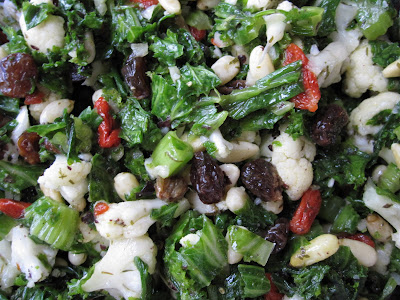
Garlic Mustard Greens and Marinated Cauliflower Salad


As I write this, autumn is in full swing. We’re entering the far side of peak fall foliage, following a somewhat subdued but still beautiful color show. Nights are cold now (most days, too) and a hard frost or two has already had its way with my basil, among other tender things.

In other words, winter is coming. In my neck of the woods, this means spending more time indoors with the windows locked up tight, breathing heated, recirculated air that may be seeded with – uh-oh – other people’s germs.

It’s been proposed that sickness increases in colder months not due to an actual increase in the amount of environmental pathogens but simply because we can’t get away from them. Indoor activities are preferred, public transportation is more crowded, fresh air is reduced, less time is spent in the sun producing Vitamin D and, of course, sugar intake skyrockets during the Holidays. All of these factors lead to increased susceptibility to disease.

It’s almost impossible not to be alarmed as news reports about "swine flu deaths" abound. What those reports fail to mention is that the sad instances of reported deaths related to H1N1 – or any flu in this country – typically occur in children and people who are already quite ill to begin with. But in a culture where "sensationalism sells" strategies support a dollar-driven healthcare system, even those of us in the natural health field may need to work harder to listen to our own sound voice of good reason.

Shameless (and in my opinion, irresponsible) advertisements for free flu shots and free antibiotics are popping up at pharmacies all over town – on billboards, LED displays, flyers – you name it. Last month, Walgreen’s was even advertising seasonal flu shots on the very same red-lit flashing outdoor sign as discounted double 12-packs of Coke and Big Grab bags of Doritos on sale. Talk about guerilla marketing.

There is nothing free about pharmaceutical drugs. On one side, just follow the money trail; on the other, the toll these poisons take on individual health and stamina. Whether today or in the future, the pipers will be paid if you buy into that system without asking questions.

I’m not saying that no one should ever take an antibiotic, or even a flu shot. Drugs like these absolutely have their place in the medicinal arsenal. But I do believe that most of the time, most of us really, honestly don’t need them.

There are many safe, natural steps we can take to boost our immune resistance to disease. A few of them are listed here, in an article I wrote for a local paper on fighting the flu with natural immune support. If there had been room, I would have definitely included a few more preventive measures, including one of my all-time favorite anti-viral aids: GARLIC!

If you think about it, garlic’s reputation for repelling vampires may not be so far-fetched. Flu viruses are merely lifeless protein packets, programmed to inject their DNA into the cellular nuclei of another, living being in order to replicate themselves. There’s definitely something vampire-like about that mechanism. (Alien and creepy, too, if not evil.)

The good news is that legends aside, garlic is a potent, scientifically proven protector against viral infection.

I have been taking advantage of garlic’s miraculous abilities since the chilly fall and winter of my nineteenth year. Due to unexpected life circumstances, I lived those frigid months just this side of homeless, spending most nights in an abandoned chicken shack and, when that flooded out, an unheated farmhouse attic. Every morning I would wake up, clamber out of my trusty down sleeping bag, get dressed with a quickness and then ride my bike down to Atkins’ Farms, the local orchard, to select a large, fresh-picked Empire apple for breakfast. This I would eat with one good-sized clove of raw garlic – a tasty combo for those who haven’t tried it. It is to the garlic that I have always attributed the fact that despite the challenges of my living situation, I did not once get sick that year, not even a sniffle.

Fortunately today I live in a cozy house, complete with wood stove and all the fixings, and from here, continue to love raw garlic. Although I generally skip the apple routine, I do consume as much as possible, especially at this time of year. Fresh chopped garlic goes well in or on just about everything - from fresh salads, raw soups and green smoothies to roasted potatoes, lentil stews, steamed veggies and more.

This winter salad is packed with immune boosting raw garlic and alkalizing mustard greens. Mustard greens, with their peppery, pungent flavor, happen to be an excellent source of vitamins A, C, E and K. The first three of these are premium cell-protective antioxidants, and eating the greens raw (though softened in a marinade) keeps levels high. A few jewel-like goji berries tossed in provide a festive air, plus sweetness and added antioxidant benefits.
Garlic Mustard Greens and Marinated Cauliflower Salad

INGREDIENTS
1 bunch mustard greens, washed and spun dry
1 head organic cauliflower, chopped into small florets
1 handful each dulse (chopped), goji berries, raisins
½ cup pine nuts

½ cup extra virgin cold-pressed olive oil
2 lemons’ juice
1 Tablespoon maple syrup or raw honey
4 cloves garlic, minced
2 Tablespoons Dill
1 teaspoon Himalayan pink salt or favorite sea salt, more to taste
½ teaspoon black pepper or crushed red pepper flakes, more to taste

DIRECTIONS
Combine fresh lemon juice, maple syrup or raw honey, garlic, dill, salt, and pepper and set aside. Finely chop the mustard greens and place in a large bowl. Pour olive oil over the greens and massage with your hands until every nook and cranny is coated. Add chopped cauliflower, chopped dulse, goji berries and raisins and stir to combine, either with your hands again, or a spoon. Add lemon juice mixture and mix well until greens, cauliflower and dried fruits are evenly coated with marinade.

Let the salad stand at room temperature for about three to four hours, stirring occasionally. I like to mix in pine nuts just before serving so they remain crispy, but you could add them earlier if you prefer. Store salad in fridge; keeps a few days…so tasty!